

-
ВОЄННИЙ Щоденник








-
FICTION/OPINION COLUMN



-
ФОТОБУК





-
Нетлінне
-





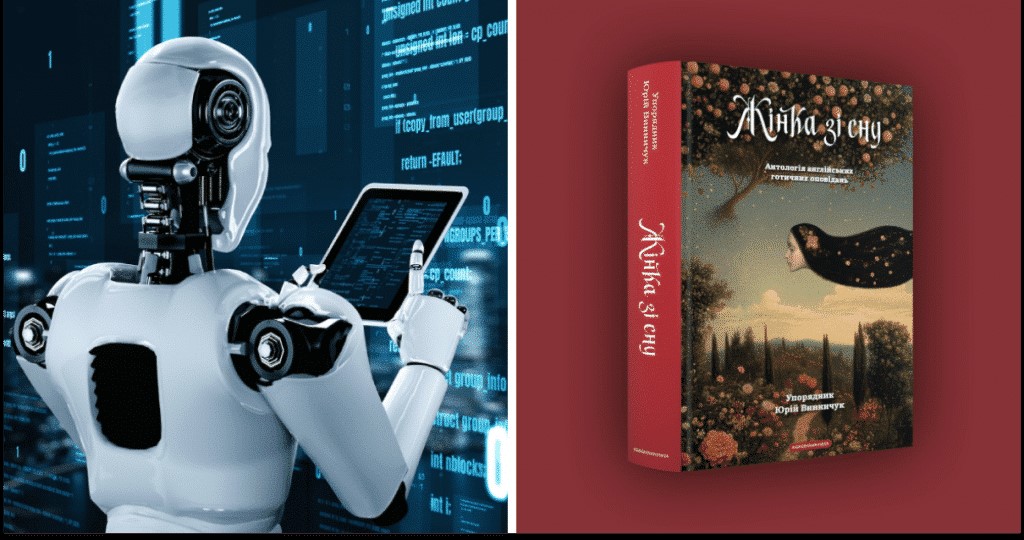
The cover looks like a fever dream. A woman’s head hanging in mid-air with a pale face and flowers in the hair — an amusing artistic solution for the magnificent illustration of a collection of Gothic English stories from the XIX–XX centuries… until it’s not artistic at all, but AI!
The book? «Жінка зі сну» (‘A Woman From a Dream’) — published by none other but ‘А-БА-БА-ГА-ЛА-МА-ГА.’ Yes, the same Ukrainian publisher known for their breathtaking illustrations, their collaboration with great artists, and their iconic visual language. But this time? AI. They called it “an experiment”, and I call it a slap in the face.
Let me clarify it — I’m not against technological progress or AI as it is. I also use ChatGPT to brainstorm ideas or ask it to help me analyze large texts or something else from time to time. I don’t think there’s anything wrong with that. But there’s a huge difference between using AI as a support tool to simplify your life and letting it replace human creativity completely.
There’s something off about praising a book cover that was generated in five minutes from datasets full of stolen, copyrighted art and then just saying that “it doesn’t break copyright law because AI cannot own rights.” Well, yeah, it cannot, and that’s the problem. No one owns it. No one made it. But someone sure is making money off it.
And it’s not just about illustrations. In 2023 and 2024, Amazon was overflowing with AI-generated books. Some were filled with incorrect health advice, historical mistakes or just ridiculously weird stories. And people were still buying them, probably thinking they were gonna read something unique and innovative…
But this isn’t innovation to me. It’s the transmission (stealing) of art to a dry algorithm that cannot feel or dream and doesn’t know what a reader wants — unless you tell it how to use a (stolen) style and describe the goal of your project.
What we really see here is a quiet disrespect to writers, illustrators, designers and editors — people who spend months (years!) building worlds, crafting ideas, drawing by hand, and shaping something that speaks to someone. AI art doesn’t speak. It answers and echoes.
Publishing is already a competitive industry. Lots of creatives get underpaid, overworked, and left out of contracts. And what we see is that some companies try to cut even more corners, using AI to speed things up and to reduce expenses. But you know what else gets reduced? Respect and value in general.
I think if publishers use AI to improve or analyze things, it’s fine. But when AI replaces the creators, it’s not about publishing anymore. It’s about printing noise and copy-pasting a mix of stolen works.
So, if you ask me whether AI in the publishing industry is cringe or not, I would say yes. When it silences real authors and artists, copies existing work, and sells it to you as “efficient progress” — then yes, absolutely, shamelessly cringe.



















Залишити відповідь