(listicle)
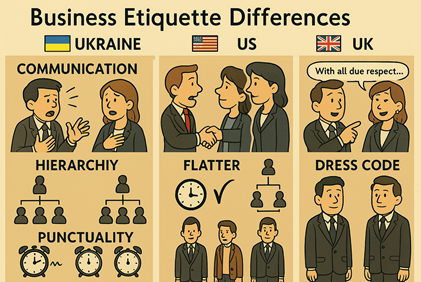
Stepping into the international business arena is like learning a new dance – especially when navigating different cultures. What’s perfectly acceptable in Kyiv might raise an eyebrow in London, and American casualness could be seen as disrespectful in Lviv. Understanding the nuances of business etiquette in Ukraine, the United States, and the United Kingdom is crucial for building rapport and sealing deals. Here are the key differences you need to know:
- Communication Style: directness vs. delicacy
- Ukraine: expect communication to be direct, yet often context-dependent. Ukrainians can be straightforward, but they value harmony and “saving face.” Personal relationships are important, so initial small talk might delve into personal topics to build trust. Emotions can be more openly expressed.
- United States: Americans prefer highly direct and transparent communication. “Time is money” is a guiding principle, so expect to get straight to the point. Conversations are typically factual, concise, and action-oriented. Small talk serves to break the ice, quickly transitioning to business.
- United Kingdom: prepare for indirect and understated communication. Brits are known for their politeness and reserve. Criticism is often veiled (“that’s an interesting idea” might mean “that’s a terrible idea”). Dry humor and self-deprecation are common. Direct confrontation is generally avoided.
- Hierarchy & Decision-Making: top-down vs. collaborative
- Ukraine: most Ukrainian companies operate with a clear, often rigid, hierarchical structure. Decisions typically flow from the top down, and respect for authority is paramount. Delegation of significant power may be less common.
- United States: the US generally features a flatter hierarchy. Communication across levels can be more open, and initiative is encouraged. Decisions are usually made relatively quickly, with an emphasis on efficiency.
- United Kingdom: while hierarchy is important, daily interactions can feel surprisingly informal. Decisions are made at higher levels but often after a more deliberative process involving discussion and consensus-building.
- Punctuality: strict adherence vs. flexibility
- Ukraine: punctuality is valued, especially for international partners. However, minor delays might occasionally be acceptable, particularly due to traffic in large cities. Arriving a few minutes early is a sign of respect.
- United States: extremely strict. Being on time (or 5-10 minutes early) is a non-negotiable sign of professionalism. Unannounced lateness is highly unprofessional.
- United Kingdom: crucially important. Punctuality is a hallmark of British business etiquette. Always arrive on time, if not slightly early.
- Dress Code: formal vs. industry-specific
- Ukraine: business attire is generally more formal. Expect suits for men and business suits or elegant dresses for women.
- United States: dress code is highly industry-dependent. While finance may require formal suits, tech often embraces business casual. When in doubt, it’s safer to overdress slightly.
- United Kingdom: traditionally formal classic business suits are the norm. Some modern sectors might lean towards smart business casual.
- Relationship Building: personal trust vs. professional contact
- Ukraine: personal relationships are key. Business is often built on trust and strong personal connections. Hospitality, including dinner invitations or toasts, is common for rapport-building.
- United States: while networking is vital, professional relationships often remain distinct from personal ones. The focus is on competence and achievements. Small talk helps break the ice, but deep personal revelations are rare in a business context.
- United Kingdom: relationships are built gradually and with restraint. Pub culture might be used for informal networking after work, but overly personal topics are generally avoided.
Understanding these differences will help you avoid misunderstandings and build effective business relationships in each cultural context.

















































Залишити відповідь