

-
ВОЄННИЙ Щоденник


-
FICTION/OPINION COLUMN



-
ФОТОБУК



-
Нетлінне
-






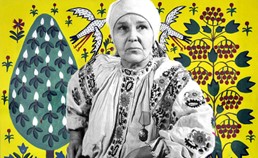
On 12 January 1909, Mariia Prymachenko (Pryimachenko) was born in the village of Bolotnia in the Kyiv region. She was brought up in a creative family and grew up surrounded by Polissia culture — she believed in mermaids, foresters, and beloved nature. Her father was a carpenter, her grandmother was a painter of Easter eggs, and her mother was a good embroiderer, who taught Mariia personally. In addition to painting and embroidery, she was also fond of ceramics and illustration.
Since childhood, she had to overcome polio. Later on, the artist suffered terrible pain all her life, had many operations and was on crutches in almost all the photos. Maria used the time she had free due to her illness to create art.
Prymachenko started painting seriously at the age of 17 when she found bluish clay and used it to paint her own house. Her neighbors liked her work and soon she received her first order. The neighbors thanked Maria for painting their house with a nice pig. Later, this piglet helped her entire family survive the famine.
After a while, a happy coincidence completely changed her life. At an exhibition of folk art, art historian Tetiana Flora noticed Mariia Prymachenko’s works. In 1936, she invited Prymachenko to study and create in her studio at the Kyiv Lavra. Mariia painted, embroidered, and became interested in ceramics.
Her first paintings were probably the motifs of wall paintings and embroidery transferred to cardboard and paper. During this period of her life, Mariia painted pictures: ‘Bull for a Walk’, ‘Blue Lion,’ ‘Mottled Beast,’ ‘Red Berries’ and others. The image of the animal world is distinguished by fantastic, fairy-tale, and folklore motifs.
The year 1936 became a landmark in the artist’s career. It was the time of the All-Ukrainian Exhibition of Folk Art, where her ‘Animals from the Swamp’ was exhibited. Mariia became famous. She was awarded a first degree diploma. Soon her works appeared at the All-Union Exhibition, and in 1937 — at the International Exhibition in Paris. And then in Warsaw, Sofia, Montreal, and Prague. Articles were published in magazines. Museums began to buy the artist’s works.
In Kyiv, Prymachenko got a chance to improve her health and underwent surgery. She also met her fellow countryman, Vasyl Marynchuk. They fell in love. Mariia was expecting a child and dreaming of a new life with her beloved man, but they did not have time to get married, the Second World War began. Her man, who was one of the first to be taken to the front, never saw his newborn son. In his last letter, he wished his son happiness and said that he was going to the fifth attack. There was no more news from him. The death of her beloved was a terrible blow that took away the artist’s desire and inspiration.
Later, she found the strength to create, but her works lost all their childishness and naivety. Since then, Prymachenko returned to the theme of war throughout her life: she dedicated her works to mass graves and soldiers.
Over the years, Mariia Prymachenko became a classic of contemporary Ukrainian folk painting and created hundreds of works that are now valued at tens of thousands of dollars. In May 2022, her works became part of the main programme of the Venice Biennale, and the world’s major media wrote about her pictures. In Ukraine, the sale of Maria Prymachenko’s works by the Prytula Foundation brought in half a million dollars for the Armed Forces. And in 2023 and 2024, exhibitions of Prymachenko’s work were held around the world.










Залишити відповідь