

-
ВОЄННИЙ Щоденник









-
FICTION/OPINION COLUMN



-
ФОТОБУК





-
Нетлінне
-






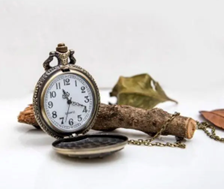
Emily had never thought much about time until her twenty-fifth birthday, when her grandfather gave her an antique pocket watch.
“It belonged to my father, and his father before him,” he said, his weathered hands trembling slightly as he placed the timepiece in her palm. “It’s special—keeps perfect time, never needs winding.”
The watch was a beautiful piece of craftsmanship: silver casing with intricate engravings of constellations, a glass face revealing delicate golden hands that moved with precise, almost hypnotic ticks. Along the edge was an inscription: Time given is never lost.
“Thanks, Grandpa,” Emily said, admiring it but not fully appreciating its significance. She placed it in her pocket and went on with her busy life.
Two weeks later, Emily was running late—as usual. Her marketing presentation was due in thirty minutes, but the file wasn’t finished, her boss was texting impatiently, and her coffee had just spilled across her keyboard. In a moment of frustrated desperation, she clutched the pocket watch in her hand.
“I wish I had more time,” she whispered.
The watch grew warm against her skin. When she looked up, everything around her had frozen—the coffee droplets hung suspended in mid-air, her computer screen stuck between pixel refreshes. The only sound was the steady ticking of the watch.
Emily stared in disbelief, then cautiously moved around her frozen office. She completed her presentation, cleaned up the coffee spill, and even organized her chaotic desk. When she finally sat down and touched the watch again, time resumed its normal flow. Her colleagues were none the wiser.
Over the next few months, Emily used the watch sparingly but strategically—fifteen minutes to prepare for an unexpected client meeting, thirty minutes to perfect a proposal, an hour to comfort a friend going through a breakup. Each time, the watch grew slightly warmer, and Emily noticed something peculiar: tiny lines were appearing on her hands, fine wrinkles that hadn’t been there before.
Concerned, she visited her grandfather.
“You’ve been using it,” he stated, not asking. His eyes, cloudy with cataracts, seemed to see right through her.
“How did you know?”
“The watch doesn’t create time, Emily. It transfers it.” He rolled up his sleeve, revealing an arm that looked decades older than the rest of his body. “Every moment you gain comes from somewhere. Or someone.”
“From you?” Emily gasped, horrified.
“My choice,” he said simply. “I’ve lived my years. Each time you use the watch, it takes from my remaining days. I wanted you to have the time I wish I’d had at your age.”
Emily tried to return the watch, but her grandfather refused.
“Time is the most precious gift one person can give another,” he said. “Just use it wisely.”
Emily kept the watch but never froze time again. Instead, she visited her grandfather every Sunday. They would sit together in comfortable silence, sometimes talking, sometimes just watching the birds in his garden. She learned to appreciate these moments more than any extra time the watch could provide.
Six months later, her grandfather passed away peacefully in his sleep. At the funeral, Emily found a note in her pocket that hadn’t been there before.
Time shared is never wasted. Wind the watch once more.
That evening, alone in her apartment, Emily wound the watch. Instead of stopping time, it began to glow softly. Projected onto her wall were moving images—her grandfather as a young man, laughing with friends, holding her grandmother’s hand at their wedding, cradling Emily as a baby.
A lifetime of memories compressed into twenty minutes. His final gift to her—not more time, but the understanding of how best to use it.
When the images faded, Emily placed the watch on her nightstand where she would see it each morning—a reminder that every tick was precious, and that sometimes the greatest use of time was simply being present in it.
























Залишити відповідь