


-
ВОЄННИЙ Щоденник

-
FICTION/OPINION COLUMN



-
ФОТОБУК



-
Нетлінне
-


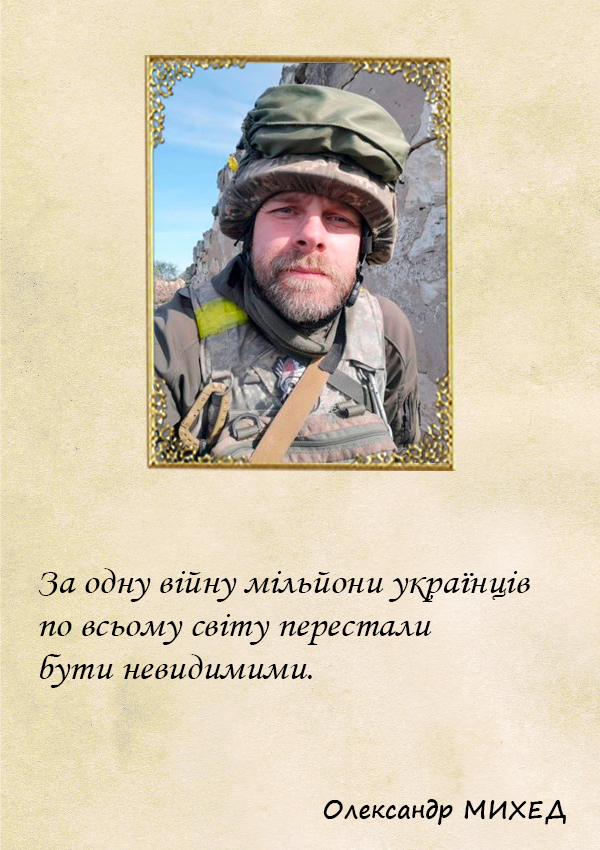




It is difficult not to write about war in such a topic. We are all not so old that any other situation could affect us more than our present. But in fact, it was the reaction of people, their actions and the “aftertaste” that remained with them even in a safe place that struck me the most. Let me start from the very beginning.
On the first day of the full-scale invasion, I was immediately ordered to pack my things. My father lived in Slovakia, so I had to go there with my grandparents and aunt. My mother planned to stay in our house. I was against it, but the stressful situation didn’t even allow me to realize that I was already in the car on the way to leave Kyiv.
It was four in the morning, on the second day of the full-scale invasion, and the streets of Kyiv had never been so quiet. Even the huge convoy of cars on the motorway didn’t seem to make a sound. The tension in the car was only occasionally interrupted by messages read out of the news on my phone.
One of the most magnificent things about our next trip to the border was a stop in the Vinnytsia region, where kind-hearted people let refugees stay in their home for the night. All the beds of the large three-room apartment were occupied, and the owners laid on the floor. Another stop was in the Ivano-Frankivsk region, with family friends in a small village. When my grandfather went for a walk, he was approached by 2-3 locals, who asked him with suspicion: “Who, when, where from,” looking for saboteurs.
There was a long line of cars at the border, and people had been waiting for days. A Czech man came up in front of us and asked if we needed “naphtha” (fuel). And this was at a time when most of the petrol stations were closed due to a shortage of fuel. In customs, everyone acted in a group – family couples, children first, old women, people with animals. On the other hand, there were columns of buses and entire tent cities of volunteers who immediately ran up to the newly arrived people and asked them in broken Ukrainian if they had anywhere to go, offering them assistance centers.
My father owns hotels in Slovakia, so he took several Ukrainians with us. Later, he said that he was shocked when he heard the first questions from people: “Where can I find a job here?” and “How much will it cost to stay in a room?” Of course, for the first six months, money was out of the question, and then people paid as much as they could, purely symbolically.
Volunteers came several times and distributed basic necessities, clothes, and food. We refused: “Give it to someone who needs it more.” The volunteers just shrugged and explained that everyone says “to someone who needs it,” and so they have travelled to several cities with a half-full car.
I jokingly told my relatives that Ukrainians in Slovakia can be distinguished by their heads on the airfield. An ordinary passenger airliner with long-forgotten white stripes in the sky. There was a little fun about it, though. People stopped and watched its trajectory in silence for a minute, seemingly almost without breathing. Nothing was more amusing than the ringtone of a Viber call heard somewhere on public transport, which only those who understood turned around and smiled. I noticed that Ukrainians on the streets almost always instinctively turned to each other for help. It was as if, in the midst of a large crowd, they felt that these were “their own,” their countrymen.
It was this cohesion of people, this mental connection of the nation, which manifested itself in the most dramatic emergency situation, that impressed me the most. The reaction to stimuli that remained with people even in a safe place, new habits, new reflexes that took a few days to develop, a few days of fear and stress. All of this will remain with our people for the rest of their lives, and only a new generation will look up at the sky and smile at the plane.














Залишити відповідь