

-
ВОЄННИЙ Щоденник



-
Життя






-
FICTION/OPINION COLUMN





-
СПОРТ



-
Нетлінне
-







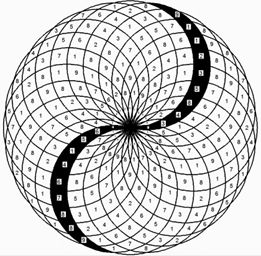
Sacred geometry represents one of humanity’s oldest attempts to understand the mathematical principles underlying natural forms and cosmic order. From the golden ratio found in sunflower spirals and nautilus shells to the geometric patterns adorning Islamic mosques and Gothic cathedrals, mathematical relationships have inspired artists, architects, and spiritual seekers throughout history to create works of transcendent beauty that reflect deeper universal harmonies.
The golden ratio, approximately 1.618, appears with remarkable frequency in both natural phenomena and human artistic creations. This proportion, known to the ancient Greeks as the “divine proportion,” creates visual relationships that the human eye finds inherently pleasing. Renaissance artists like Leonardo da Vinci and Piero della Francesca incorporated golden ratio proportions into their paintings, while architects have used these relationships to create buildings that achieve perfect visual balance.
The Platonic solids—tetrahedron, cube, octahedron, dodecahedron, and icosahedron—represent perfect three-dimensional forms that have fascinated mathematicians and philosophers for millennia. These geometric shapes appear in crystal structures, viral forms, and molecular configurations, suggesting that mathematical principles operate at the most fundamental levels of physical reality. Their aesthetic appeal transcends scientific interest to inspire artistic creations across cultures and centuries.
Islamic geometric patterns demonstrate how mathematical principles can generate infinite complexity from simple rules and relationships. The intricate tessellations adorning mosques and manuscripts avoid representational imagery while creating visual experiences of remarkable richness and sophistication. These patterns reflect theological concepts about the infinite nature of divine reality while showcasing human capacity for mathematical creativity and precision.
The spiral forms found throughout nature—from galaxy arms to seashells to plant growth patterns—often conform to mathematical relationships like the Fibonacci sequence. This numerical series, where each number equals the sum of the two preceding numbers, generates spiral proportions that appear in countless natural phenomena. The mathematical consistency underlying such diverse forms suggests fundamental organizing principles that operate across all scales of existence.
Mandala traditions in Hindu and Buddhist cultures employ geometric patterns as tools for meditation and spiritual practice. These circular designs use mathematical symmetry to create focal points for contemplation while symbolizing cosmic order and consciousness itself. The precise geometric construction of traditional mandalas requires mathematical knowledge while serving religious and psychological purposes that transcend purely aesthetic considerations.
Contemporary artists and architects continue exploring sacred geometry’s potential for creating meaningful visual experiences. Architects like Louis Kahn and Tadao Ando have incorporated geometric principles into buildings that achieve spiritual impact through mathematical harmony, while digital artists use computer algorithms to generate complex geometric patterns that would have been impossible to create manually.
The psychological appeal of geometric patterns may reflect deep-seated human needs for order and pattern recognition that evolved to help our ancestors navigate complex environments. Research suggests that humans have innate preferences for certain proportions and symmetries that correspond to mathematical relationships found throughout nature. This biological basis for aesthetic preference supports claims about sacred geometry’s universal appeal.
The study of fractals has revealed how simple mathematical rules can generate infinite complexity and self-similarity at different scales. Natural phenomena like coastlines, clouds, and tree branching patterns display fractal characteristics that suggest mathematical principles operating at levels of detail that exceed human perception. This discovery has opened new possibilities for understanding the relationship between mathematics and natural beauty.
Sacred geometry ultimately demonstrates that mathematics is not merely an abstract intellectual exercise but a fundamental aspect of reality that manifests in forms of extraordinary beauty and meaning. Whether viewed from scientific, artistic, or spiritual perspectives, geometric principles provide a common language for exploring the deep structures that underlie both natural phenomena and human creative expression, bridging the gap between rational understanding and aesthetic experience.






















Залишити відповідь